How New Mexico’s regions influence remodeling decisions
New Mexico cannot be treated as a single, uniform building environment. Elevation, precipitation, soil, vegetation, temperature, and local construction traditions create distinct regional conditions.
Albuquerque and the central Rio Grande Valley
Albuquerque-area homes experience strong sunshine, hot summers, cool winter nights, seasonal monsoon storms, and persistent temperature variation. Roofing membranes, sealants, exterior coatings, and window assemblies must tolerate ultraviolet exposure and repeated thermal movement.
Drainage remains important even in a dry climate. Short periods of heavy rain can expose roof-drainage problems, poor grading, clogged canales, undersized scuppers, or water collecting near a foundation.
Santa Fe and north-central New Mexico
Higher elevations bring colder winter temperatures, snow, freeze-thaw cycles, and substantial differences between daytime and nighttime conditions. Insulation continuity, air sealing, roof drainage, and properly protected plumbing become particularly important.
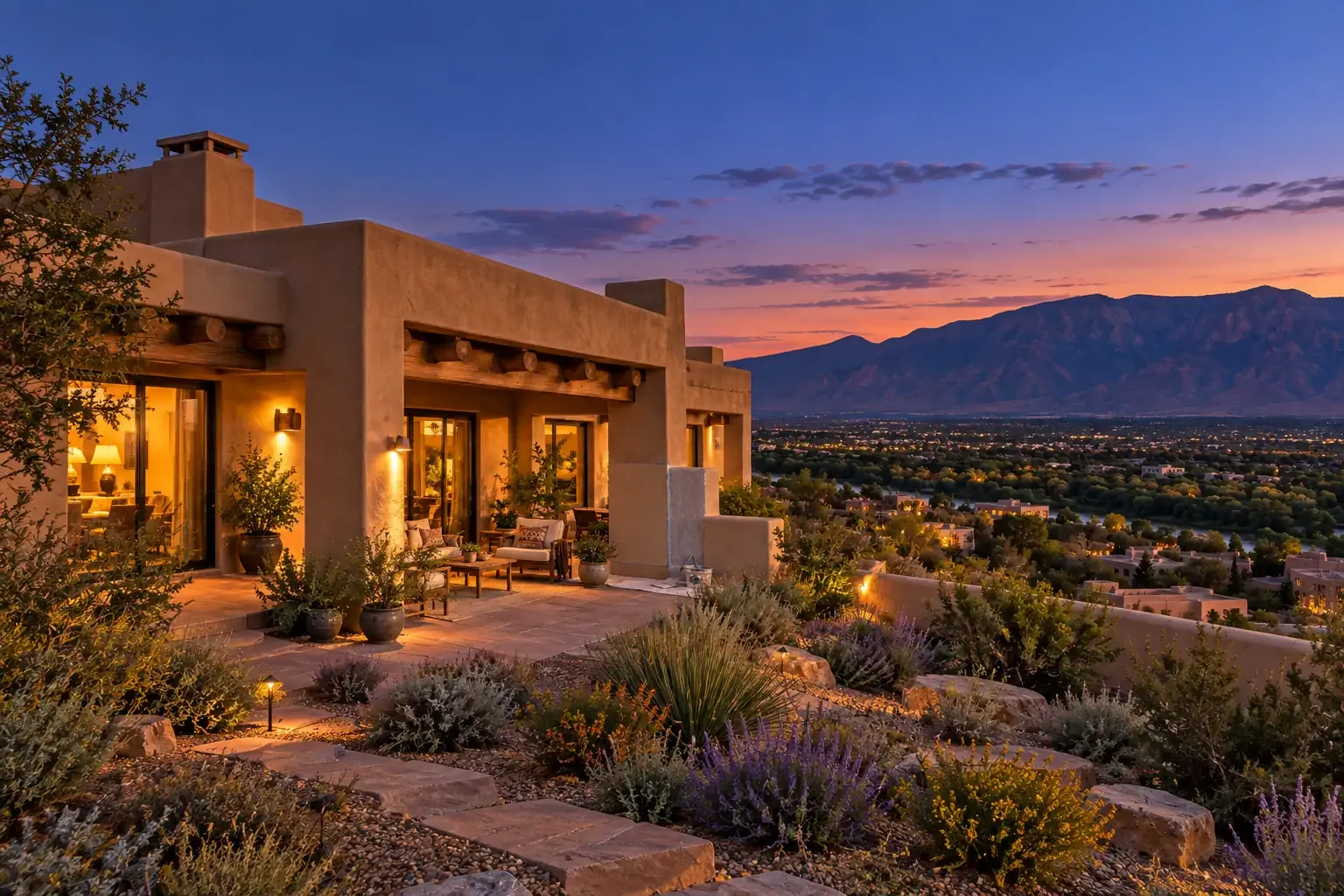
Many homes reflect Pueblo Revival, Territorial, or adobe-influenced architecture. However, a home that looks like adobe may be built with masonry, wood framing, structural adobe, or a combination of systems. Remodeling decisions should be based on the actual wall assembly rather than appearance alone.
Northern mountains and forested elevations
Mountain communities may face snow accumulation, ice, colder winters, limited site access, and greater wildfire exposure. Roof geometry, attic ventilation, insulation, heating reliability, exterior material selection, and vegetation management may carry more weight in these areas.
Remote or sloped sites can also affect material delivery, equipment access, construction scheduling, and emergency planning.
Las Cruces and southern New Mexico
Southern New Mexico generally places greater emphasis on cooling performance, solar control, drought-conscious landscaping, and materials that tolerate heat and ultraviolet exposure. Efficient windows, exterior shading, insulation, air sealing, and properly sized cooling systems can work together to reduce heat gain.
Dust and wind may also influence exterior openings, HVAC filtration, weatherstripping, and the maintenance needs of mechanical equipment.
Eastern plains and rural communities
Homes in eastern New Mexico may experience high winds, hail, sharp weather changes, and greater exposure due to open terrain. Roofing attachment, impact resistance, flashing, siding condition, and window performance deserve careful evaluation. Rural properties may also rely on wells, septic systems, propane, or other site-specific utilities that need to be considered during a remodel.
Roofing, stucco, siding, windows, and drainage
A home’s exterior systems work together. Roof drainage can affect stucco and foundations. Window installation can affect air leakage and wall moisture. Exterior coatings can protect a wall, but they cannot correct water entering from failed flashing above it.
Roofing in a high-sun environment
New Mexico roofs receive prolonged solar exposure. Ultraviolet radiation and surface heat can age coatings, sealants, asphalt products, exposed fasteners, and some roof membranes. Thermal expansion and contraction may gradually open vulnerable joints or reveal weak transitions around skylights, parapets, vents, and mechanical penetrations.
Common roof considerations include:
- Condition of membranes, shingles, tiles, coatings, and flashing
- Drainage through scuppers, canales, gutters, and downspouts
- Ponding water on low-slope or flat roofs
- Parapet wall and coping condition
- Wind and hail exposure in open or elevated areas
- Snow load and freeze-thaw conditions at higher elevations
- Compatibility between new roofing products and the existing assembly
A roof coating may extend the service life of a suitable roof, but it should not be treated as a universal repair. Wet insulation, deteriorated decking, failed flashing, or structural movement may require more complete work.
Stucco and adobe-related walls
Stucco is common throughout New Mexico, but the material beneath it varies. The wall may contain wood framing, concrete masonry, structural adobe, or another substrate. Each system handles moisture and drying differently.
Cracks should be evaluated by pattern and cause. Fine surface cracking may be primarily cosmetic, while wider, recurring, stair-step, or displaced cracks can indicate movement or failure beneath the finish. Repair materials should be compatible with the existing wall so that moisture is not unintentionally trapped.
Traditional earthen adobe requires particularly careful treatment. Incompatible cement-rich coatings or poorly detailed drainage can prevent appropriate drying and contribute to deterioration. Owners of adobe and historic homes may benefit from a contractor or preservation professional familiar with earthen construction.
Siding and exterior trim
Where siding is used, material selection should account for heat, ultraviolet exposure, wind, and large temperature changes. Wood needs appropriate finishing and maintenance. Vinyl and composite products require installation details that allow for movement. Fiber-cement, metal, and engineered materials each have their own attachment, clearance, and flashing requirements.
Regardless of material, siding should not be expected to compensate for missing flashing, poor roof drainage, or persistent contact with soil.
Windows and exterior doors
Window remodeling in New Mexico often centers on solar heat gain, air leakage, ultraviolet exposure, and winter comfort. Glass performance matters, but installation quality and shading can be equally important.
Useful considerations include:
- Window orientation and daily sun exposure
- Low-emissivity glass suited to the home’s heating and cooling needs
- Air sealing around the frame
- Flashing and drainage at the rough opening
- Exterior shading from overhangs, awnings, shutters, or appropriate landscaping
- Operation, emergency egress, and accessibility
West-facing glass can introduce substantial afternoon heat. In some rooms, exterior shading or solar-control strategies may improve comfort more effectively than changing the window alone.
Gutters, canales, and site drainage
New Mexico’s low annual rainfall can make drainage seem secondary. Monsoon storms show why it is not. A brief, intense downpour may send a large volume of water toward roof drains and foundations in a short period.
Roof outlets should discharge where water can move safely away from the structure. Soil grading, hardscape, courtyards, retaining walls, and landscape features should be reviewed as part of the same water-management system.
Insulation, HVAC, and year-round indoor comfort
New Mexico’s dry air does not eliminate building-envelope problems. Air leakage can carry dust, reduce comfort, increase heating and cooling demand, and create large temperature differences between rooms.
Insulation and air sealing
Insulation performs best when it is continuous and paired with deliberate air sealing. Common weak points include attic access panels, plumbing penetrations, recessed fixtures, duct chases, rim areas, and transitions between additions and the original house.
Before adding insulation, it is useful to inspect for:
- Roof or plumbing leaks
- Damaged or compressed insulation
- Unsealed penetrations
- Duct leakage
- Unsafe clearances around heat-producing equipment
- Evidence of pests or previous moisture intrusion
Insulation strategy should reflect the home’s construction. A vented attic, unvented roof assembly, adobe wall, masonry wall, and conventional wood-framed wall do not manage heat and moisture in the same way.
Heating and cooling systems
HVAC choices vary by region and elevation. Evaporative cooling can perform well under suitable dry-air conditions, but its effectiveness declines during more humid monsoon periods. Refrigerated air conditioning and heat pumps offer different performance characteristics and may require electrical, duct, or building-envelope improvements.
Equipment should be sized from the home’s actual heating and cooling load rather than simply matching the capacity of the old system. Oversized equipment can cycle frequently, create uneven comfort, and operate less efficiently.
A broader HVAC review may include:
- Duct location, condition, insulation, and leakage
- Return-air pathways
- Room-by-room temperature differences
- Filtration for dust and airborne particles
- Combustion safety where fuel-burning appliances remain
- Electrical capacity for heat pumps or refrigerated cooling
- Ventilation needs after extensive air sealing
Passive comfort strategies
Mechanical equipment is only one part of indoor comfort. Roof reflectivity, window shading, thermal mass, ceiling fans, exterior color, vegetation placement, and nighttime ventilation under suitable conditions can all influence indoor temperature.
The most effective combination depends on elevation, orientation, home design, and occupancy. A strategy that works well in Las Cruces may not be appropriate for a shaded mountain home.
Kitchen, bathroom, and flooring considerations
Kitchen remodeling
Kitchen remodeling often affects more than cabinets and countertops. Older homes may need electrical, plumbing, ventilation, lighting, or structural updates before new finishes are installed.
Useful planning questions include:
- Can the existing electrical service support new appliances?
- Does the range hood exhaust outdoors appropriately?
- Will plumbing relocation affect the slab, crawlspace, or walls?
- Are natural stone, tile, or concrete surfaces suitable for the floor structure?
- Can the layout improve accessibility and safe movement?
- Would water-efficient fixtures support long-term conservation goals?
New Mexico kitchens may also benefit from shaded outdoor cooking or dining areas. These spaces should be planned around wind, fire safety, utility routing, weather exposure, and safe separation from combustible materials.
Bathroom remodeling
Bathrooms remain moisture-intensive rooms even in an arid climate. Shower walls, floors, plumbing penetrations, and transitions require reliable waterproofing. Tile and grout alone do not form a complete waterproof assembly.
Bathroom remodeling can also provide an opportunity to improve ventilation, lighting, water efficiency, slip resistance, and accessibility. Curbless showers, reinforced walls for future grab bars, wider clearances, and lever-style hardware can support long-term use when incorporated during initial planning.
The U.S. Environmental Protection Agency’s WaterSense program provides information about water-efficient fixtures and products.
Flooring selection
Tile, brick, concrete, wood, engineered wood, resilient flooring, and carpet all appear in New Mexico homes. Selection should account for the substrate, room use, direct sunlight, temperature variation, and transitions between materials.
Concrete slabs may develop cracks that transfer through rigid finishes if movement is not addressed. Wood products need suitable acclimation and installation even in a dry environment. Strong sunlight can also fade or heat some flooring materials near large windows.
Before installing a new floor, evaluate the flatness, stability, and moisture condition of the substrate. Covering an unresolved crack or moisture problem rarely removes its cause.
Foundation and structural repair considerations
Foundation movement is influenced by soil composition, drainage, site grading, construction type, vegetation, plumbing leaks, and changes in moisture around the home. New Mexico contains varied geology, so broad statewide assumptions are not reliable for an individual property.
Possible signs of movement include:
- Recurring or widening wall cracks
- Doors and windows that no longer operate properly
- Sloping or uneven floors
- Separation between walls, ceilings, or exterior finishes
- Cracked slabs or displaced tile
- Gaps around additions or attached structures
- Water collecting near the foundation
Not every crack indicates serious structural failure. Materials shrink, coatings age, and buildings move slightly over time. The location, direction, width, displacement, and rate of change provide more useful information than the mere presence of a crack.
Where significant movement is suspected, an evaluation by a qualified structural engineer or other appropriate professional can help distinguish cosmetic repair from structural work. Drainage and plumbing conditions should also be considered so that repairs address contributing causes where possible.
Wildfire-aware remodeling in forested and rural areas
Wildfire risk is not limited to the wall of flame visible from a property. Windborne embers can enter vulnerable roof edges, vents, gaps, decks, and other exterior transitions. Remodeling cannot eliminate wildfire risk, but thoughtful material and detailing choices may reduce some vulnerabilities.
Wildfire-aware planning may include:
- Evaluating roof coverings and roof-edge details
- Reducing gaps where embers may collect or enter
- Reviewing vents, soffits, decks, and attached fences
- Selecting appropriate exterior cladding and trim
- Maintaining clear access around the property
- Managing vegetation and combustible materials near the home
- Coordinating home-hardening work with a broader defensible-space plan
Product labels such as “fire-resistant” should not be interpreted as “fireproof.” Assembly design, installation details, maintenance, surrounding vegetation, and local fire behavior all matter. Homeowners should consult current state, local, and fire-district guidance for their location.
How to plan a New Mexico remodeling project
A remodeling plan becomes more reliable when the work is organized around material, dimensions, condition, context, and intent. These factors help clarify what exists, what is failing, what the environment demands, and what the homeowner wants the project to accomplish.
1. Define the project’s purpose
Determine whether the goal is repair, replacement, energy improvement, accessibility, added space, cosmetic renewal, or long-term risk reduction. Several goals may overlap, but naming them helps establish priorities.
2. Document existing conditions
Photograph affected areas, record when problems occur, and gather available plans, inspection reports, warranties, utility information, and previous repair records. A stain that appears only during wind-driven rain provides different information than one that grows beneath a plumbing fixture.
3. Identify connected systems
Remodeling one part of a home can affect another. Window replacement may disturb stucco. HVAC work may require electrical upgrades. A kitchen layout change may affect plumbing, structure, flooring, and ventilation. Roof drainage may influence foundation conditions.
4. Evaluate material compatibility
New materials should be compatible with the existing building. This is especially important for adobe, historic masonry, older plaster, low-slope roofs, and additions constructed differently from the original home.
5. Account for regional exposure
Consider elevation, sun orientation, wind, hail, snow, wildfire exposure, dust, site drainage, and access. Regional context can change which materials and details are appropriate.
6. Confirm permits and current requirements
Permit and inspection requirements may vary by municipality, county, project type, and property location. Structural changes, electrical work, plumbing, mechanical systems, additions, and some exterior alterations commonly require formal review.
Historic districts, homeowner associations, wildfire zones, utility providers, and properties with wells or septic systems may introduce additional considerations. Verify current New Mexico remodeling permits and local building requirements before work begins rather than relying on older project information.
7. Plan the sequence of work
Repairs should generally move from underlying causes toward visible finishes. For example, a roof or plumbing leak should be resolved before replacing damaged drywall. Structural and substrate repairs should occur before flooring or tile installation.
8. Preserve maintenance access
Equipment, shutoff valves, cleanouts, filters, roof drains, and other service points should remain accessible after remodeling. A visually clean finish should not make future inspection or maintenance unnecessarily difficult.
Common remodeling priorities by condition
Examples of home conditions and the systems that may need evaluation
| Observed condition | Systems to examine | Why context matters |
|---|---|---|
| Hot rooms or high cooling demand | Windows, shading, attic insulation, air sealing, ducts, HVAC sizing | Sun orientation, elevation, and home design affect heat gain |
| Stucco cracking or staining | Roof drainage, flashing, wall substrate, foundation movement, coatings | Surface repair may not address movement or water entry |
| Water near the foundation after storms | Grading, canales, gutters, downspouts, hardscape, roof outlets | Monsoon rainfall can overwhelm weak drainage paths quickly |
| Uneven indoor temperatures | Insulation, air leakage, ductwork, equipment sizing, solar exposure | Mechanical and building-envelope problems often overlap |
| Recurring floor or wall cracks | Foundation, slab, drainage, plumbing, framing, finish materials | Crack pattern and change over time are more informative than presence alone |
| Aging flat or low-slope roof | Membrane, coating, drainage, parapets, flashing, roof deck | Ultraviolet exposure and ponding water can accelerate deterioration |
Remodeling for the home and the landscape
New Mexico homes exist within a varied landscape of deserts, river valleys, mountains, forests, plains, and high-elevation communities. Durable remodeling begins by understanding that setting and then examining how the home’s materials and systems respond to it.
Roofing, drainage, stucco, windows, insulation, HVAC, foundations, kitchens, bathrooms, and flooring should not be planned as isolated components. Each belongs to a connected building. When environmental exposure, existing construction, material compatibility, and long-term maintenance are considered together, remodeling decisions become clearer and more useful over time.